
The pilot is where it starts.
The book ends with a question: whether you want to explore AI to support the development of the neglected 98%. If the answer is yes, the pilot is where it starts.
The book
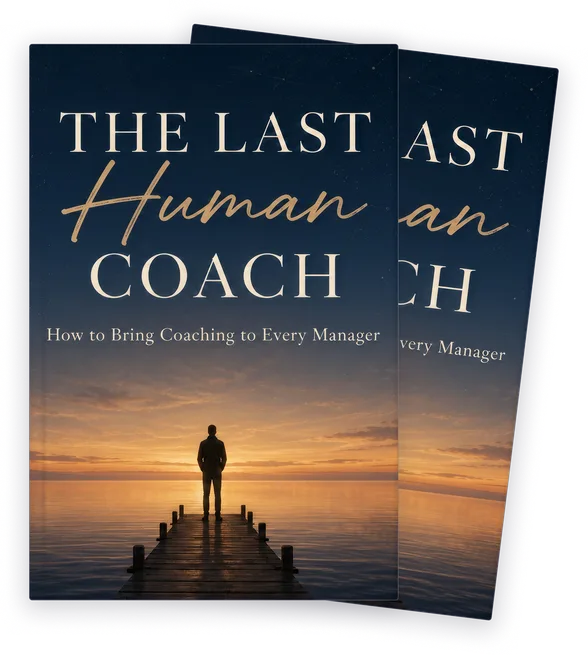
How to Bring Coaching to Every Manager
Somewhere in your organization tonight, a manager is asking an AI how to handle tomorrow's hardest conversation. Nobody chose that tool, and nobody checked it. It simply arrived.
The Last Human Coach is about doing on purpose what is already happening by accident. Written by a retired admiral who became a certified coach and then helped build a machine to do his own job, it explains what AI coaching does well, documents five specific ways it fails, and gives you the tests to tell the difference, including on the author's own product.
Coaching used to reach 2% of your people. What happens now is a decision. This book is how you make it well.
Why this book?
Your managers are already being coached by AI: unmanaged, unmeasured, at eleven at night, by whatever tool they found. The only open question is whether the coaching they get is designed or accidental.
Traditional development never reached most of them. Coaching worked, and almost nobody could have it: the arithmetic of one coach per hundred managers kept it a privilege of the top 2%.
Machines can now do the part of coaching that scales: perception, memory, tireless attention, the right question at the right moment. The book shows real transcripts of it going well and going badly.
They fail in five documented ways, from flattery to running one method on every human alike. Each failure comes with a test you can run tonight, on any system — the author asks you to run them on his first.
And the human coach is not finished. The machine took the part of the work that was never the reason to pay for a person, and handed back the part that always was.
Who it's for
You do not need to know anything about AI to read it. You need to have people, and the honest wish to grow them.
If you lead HR, talent, or learning and development, if the budget, the vendors, and the question “what are we doing about AI coaching?” land on your desk, the book is a working instrument: the failure modes to watch for, a scorecard for evaluating any system on the market, and a ninety-day pilot you could charter next Monday.
Then for coaches, the crew the author belongs to, including the one chapter written directly to their fear, dissecting it into what's real and which parts of it are wrong. Coaches who read it will find their judgment is worth more than before, not less. They will also find out why.
And it is for the leader who simply suspects their people deserve better than nothing, who knows that somewhere in the building tonight, a new manager is rehearsing a hard conversation alone. Coaching reached 2% of them for fifty years. This book is about the other ‘neglected’ 98.
The eight criteria
Bring them to every vendor, including us.
How does iLeader hold up against all eight? Ask us in the scoping session. We will answer in writing.
Does the system recognize the edge of its competence, and does the handoff lead somewhere appropriate?
Can anyone use what a person says in coaching against them?
What governs the coaching choices the system makes?
Does the system know what kind of conversation is taking place, and does it change modes deliberately?
Can the system carry a developmental thread accurately across time, and can the Coachee correct or delete it?
Can the system reopen a confident bad decision instead of admiring it?
What evidence shows the system is useful and safe?
What happens when the model or product changes?
The instruments
They are working documents, meant to be printed, filled in, argued over in a room, and signed. Take them, adapt them, and put your own organization's name at the top.
For evaluating systems and deciding which one earns a pilot. Use it first.
What you sign before the pilot begins: one page that fixes your criteria while you can still be honest about them. Use it after the scorecard.
The technical companion to the charter, where the version freeze, data flows, comparison design, and amendment log live, so the charter itself can stay on a single page. Use it last.
About the title
The Last Human Coach sounds like an elegy about a profession close to being automated into memory. The author chose it because that is the fear, stated in four words, and he felt it himself before he understood what he was looking at.
“Last” is a position, not a termination.
The book argues the phrase means nearly the opposite of how it reads: the coach at the far end of the old model, the one who came up entirely inside one human and one conversation at a time, the twenty-client ceiling, the appointment book. That coach is genuinely the last of a line. What comes next is not the end of the work. It is the same craft, split in two: the part that can now be multiplied to everyone, and the part that never will be, which turns out to be the only part that was ever truly the coach's own.
What that second part is and why it survives are the questions the book takes ten chapters to answer honestly.

The book ends with a question: whether you want to explore AI to support the development of the neglected 98%. If the answer is yes, the pilot is where it starts.